




Housing Supply is not only construction. It is also Circulation
A Personal Note Before I Begin
I believe citizenship carries responsibilities as well as privileges. There are times when each of us, in whatever field we know best, has an opportunity to contribute something that might help the country work a little better.
This is my attempt to do that.
The ideas I am beginning to publish here are not being developed with an expectation of compensation. I am putting them forward because I believe America’s housing market has a structural problem that deserves serious attention—and because I believe there may be a practical way to address part of it.
I don’t expect every conclusion to survive scrutiny unchanged. In fact, I hope economists, policymakers, housing professionals, lenders, builders, and others will challenge the work. Good public policy should become stronger through that process.
But I do believe we have an obligation, when we see a problem and think we may have something useful to contribute, to put the idea forward.
So that is what I am going to do.
And it begins with a different way of thinking about housing supply.
For most of the housing debate, we have asked one overriding question:
How do we build more homes?
It is an essential question.
But I increasingly believe it is only half of the housing-supply equation.
There is another question that deserves far more attention:
How effectively are the homes we already have moving from one household to the next?
That distinction has become particularly important in the housing market of the 2020s.
Millions of homes exist across the United States that could, under different circumstances, become the next home of a first-time buyer, a growing family, a relocating worker, or a downsizing retiree.
But many of those homes are not entering the market.
They are effectively stuck.
And that suggests we need another way of thinking about housing supply.
I call it Housing Circulation Policy.
Physical Supply and Effective Supply
Traditional housing policy understandably concentrates on physical supply.
How many homes exist?
How many are being constructed?
How much land can accommodate additional development?
How quickly can projects be permitted?
Those questions remain critically important. America needs additional housing construction, particularly in markets where structural shortages and regulatory barriers have constrained development.
But there is another kind of supply that receives considerably less attention.
Effective supply.
Effective supply is not simply the number of homes that physically exist.
It is the number of housing opportunities actually available because households are able and willing to move.
That distinction matters.
A home can exist physically while contributing almost nothing to the active housing market.
And when that happens across millions of households, the consequences begin to resemble a supply shortage even though the structures themselves already exist.
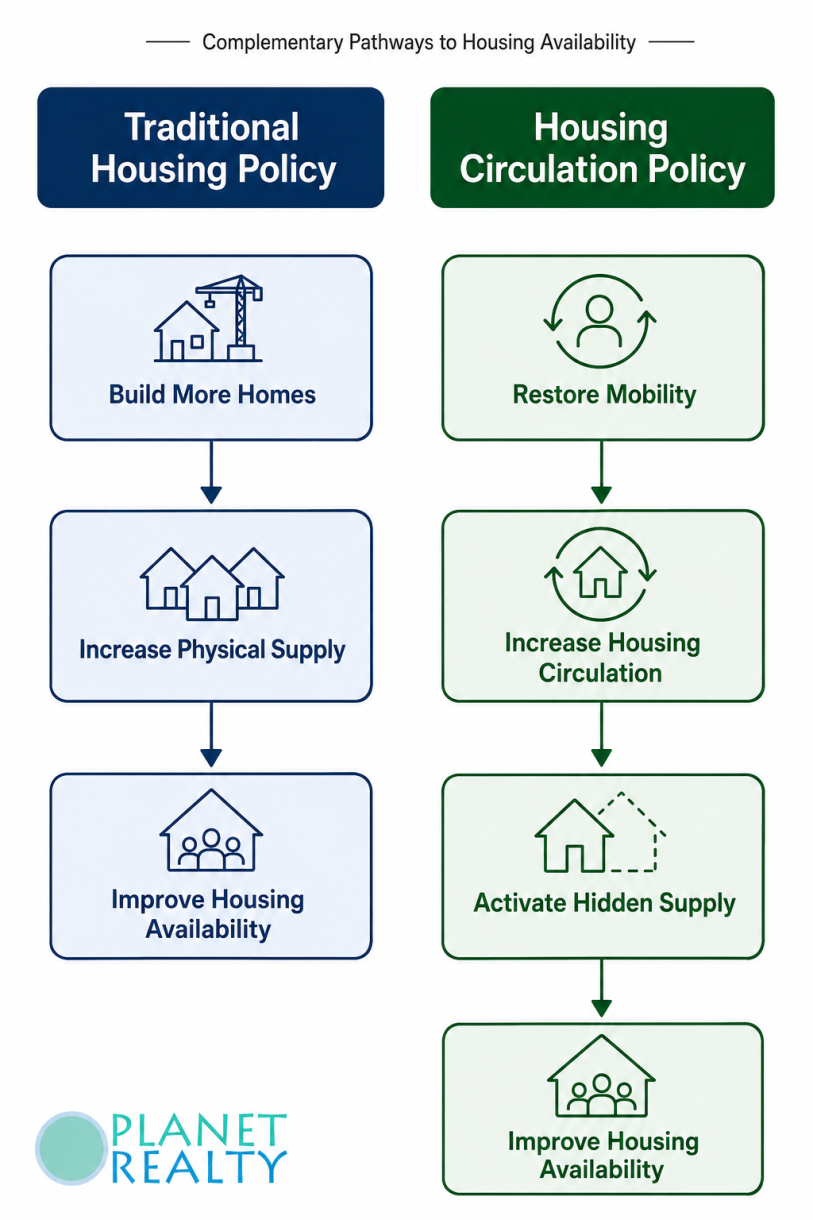
Figure 1. Two complementary pathways to housing availability. Traditional housing policy expands physical housing supply through construction. Housing Circulation Policy focuses on restoring mobility through the existing housing stock, activating what this framework describes as “Hidden Supply.”
The Mortgage Lock-In Problem
The clearest example today is mortgage-rate lock-in.
Millions of American homeowners purchased or refinanced homes during the extraordinarily low-rate period surrounding 2020–2022.
Many now hold mortgages with rates far below prevailing market rates.
Those mortgages are valuable financial assets.
Selling the house generally means surrendering that financing and replacing it with a substantially more expensive mortgage.
That creates an unusual economic calculation.
A household may want a larger home.
A worker may want to relocate for a better job.
Parents may want to move closer to family.
An empty-nest household may want to downsize.
But moving can require exchanging an exceptionally inexpensive mortgage for a considerably more expensive one.
The rational financial decision may therefore be:
Don’t move.
For one household, that is simply a personal financial choice.
Across millions of households, it becomes a housing-market phenomenon.
The Hidden Supply
This is where I think the traditional housing conversation is missing something important.
When a homeowner who would otherwise move stays in place because of mortgage lock-in, one transaction does not merely disappear.
A home also fails to enter the market.
Imagine a family living in a starter home.
They would normally sell that home and purchase something larger.
Their starter home might then be purchased by a younger household moving from renting into ownership.
The larger home might be sold by an older household downsizing.
That household might move into a smaller home or condominium.
One move facilitates another.
That is the housing ladder.
When movement slows at one point in that system, the effects propagate through the rest of it.
The starter home never reaches the first-time buyer.
The family does not move up.
The downsizer may remain in a house larger than needed.
The next transaction never occurs.
The homes still exist.
What disappears is their availability.
I think of this as The Hidden Supply: housing that physically exists but is effectively unavailable because the households occupying it are not moving.
Housing Is a Circulation System
This leads to a broader proposition that I believe deserves serious consideration:
Housing supply is not only construction.
Housing supply is also circulation.
A functioning housing market requires both.
Construction increases the number of physical units.
Circulation determines how efficiently existing units move between households.
The distinction is similar to other markets.
An economy does not function merely because capital exists. Capital has to move toward productive uses.
A labor market does not function merely because workers exist. Workers need to be able to move toward opportunity.
And a housing market does not function merely because houses exist.
Households have to be able to move through them.
That is the idea behind Housing Circulation Policy.
This Is Not an Argument Against Building
It is important to be precise about what this framework does and does not mean.
Housing Circulation Policy is not an alternative to construction.
America still needs to build.
Zoning reform matters.
Permitting reform matters.
Infrastructure matters.
Construction financing matters.
Labor and material costs matter.
But those policies primarily address future physical supply.
Circulation policy asks a different question:
What can we do about housing opportunities that already exist but are not reaching the market?
Those two approaches should complement one another.
A more complete national housing strategy would therefore pursue both:
Build more housing.
And:
Help existing housing move.
Reconnecting the Housing Ladder
The implications extend beyond individual sellers.
Consider a move-up homeowner who wants to purchase a newly constructed house.
If mortgage lock-in prevents that household from moving, two things can happen simultaneously.
The new home remains unsold.
And the family’s existing home never reaches the market.
The result is a blockage between new construction and existing housing.
If that household can move, the opposite occurs.
The builder sells the completed home and recovers capital.
The existing homeowner releases another property.
Another household can purchase that home.
Capital can return to the development pipeline.
The housing ladder begins moving again.
This is why circulation should matter to builders, lenders, policymakers, economists, real estate professionals, employers, and communities—not simply existing homeowners.
Housing mobility connects different parts of the market that are too often analyzed separately.
A New Policy Question
The traditional housing-policy question is:
How do we increase the number of homes?
Housing Circulation Policy adds another:
How do we increase the number of housing opportunities created by the homes we already have?
I believe that question will become increasingly important.
It also raises difficult policy questions.
Can mortgage lock-in be reduced without creating another permanent housing subsidy?
Can policy encourage mobility without simply increasing housing demand?
Can additional existing-home inventory be directed toward owner-occupants rather than simply increasing investor acquisition?
Can a temporary intervention generate enough additional mobility to justify its fiscal cost?
And perhaps most importantly:
Can we measure whether it actually works?
Those are questions I have been working on.
What Comes Next
Over the past several months, I have been developing a broader policy framework around Housing Circulation Policy and the mortgage lock-in problem.
That work has led to a specific proposal:
The Housing Mobility and Homeownership Act — HMHA.
The proposal is built around a relatively simple objective:
Reduce the financial friction preventing some homeowners from moving, release existing homes back into the owner-occupied market, and reconnect the housing ladder.
The framework is designed to be temporary, targeted, measurable, and fiscally bounded.
There is considerably more to say about how it could work, who should qualify, how owner occupancy could be protected, what it might cost, and—equally important—what could go wrong.
I will be publishing more of that work.
For now, I want to put the underlying idea into the housing-policy conversation.
We have spent decades thinking about housing supply primarily as a construction problem.
Construction remains essential.
But the housing market of the 2020s has exposed another dimension of supply that deserves its own policy framework.
Physical supply tells us how many homes exist.
Housing circulation tells us how effectively those homes become available to the next household.
If we want a housing market that works better for families, workers, buyers, builders, lenders, and communities, we need to think about both.
Because ultimately:
A housing market works when people can move.
Today, millions cannot.
And somewhere inside that immobility may be one of the largest untapped sources of housing opportunity already sitting in plain sight.
The housing challenge right now has two distinct halves. The first is production, which gets most of the attention. The second is circulation, which determines whether the homes already built are actually doing any work in the market. A home that cannot list, finance, transfer, or close efficiently is not functioning as supply, regardless of what it looks like on a balance sheet or in a housing count.
For executives, lenders, servicers, investors, and real estate leaders, this distinction has direct operational relevance. Many of the constraints your teams are working around right now, whether that shows up as suppressed origination volume, delayed asset disposition, or thin transaction pipelines, trace back to stalled movement in existing housing stock rather than an absence of homes. Naming that dynamic accurately is the first step toward responding to it well.
This article works through the circulation problem from the market level down to the policy and operational level. It starts with where the market stands right now, moves into why circulation has slowed so sharply, identifies the specific friction points creating the drag, and then covers what practical circulation policy actually looks like. The goal is to give you a framework and language that is useful in planning conversations, not just interesting in theory.
The Market Has Homes But Too Many of Them Are Stuck
A home sitting in probate, loss mitigation, or behind a rate barrier that makes listing financially irrational is not the same thing as available housing. That distinction matters more right now than most market summaries acknowledge.
Active listings have improved in 2026, which is a genuinely positive development. But they remain below typical 2017 to 2019 levels, meaning the recovery is real without being complete. As of July 2026, existing-home sales were running at roughly 4.06 million annually, with 1.54 million unsold homes on the market and a 4.6-month supply. Those numbers suggest a market that is healing, but they do not tell you how much of that inventory is genuinely transactable versus functionally stuck.
That gap between total stock and effective supply is where the circulation concept becomes operationally useful. A market can look better on paper while still behaving like a low-liquidity system, and that is roughly where much of the U.S. housing market sits today. Prices remain elevated in many regions not because demand has surged, but because the homes that should be cycling through the market are not moving.
For anyone shaping lending strategy, investment theses, or servicing operations, the relevant question is not just how many homes are out there. It is how many of those homes are capable of completing a transaction in a reasonable timeframe. The answer to that second question is considerably smaller than the headline inventory figures suggest, and the gap between the two numbers is where risk accumulates quietly.
Three terms worth adding to your planning vocabulary are effective supply, market liquidity, and housing flow. Effective supply refers to the share of total housing stock that is genuinely available and transactable. Market liquidity describes how easily homes are moving between owners. Housing flow captures the rate at which existing homes cycle from one household to the next. All three give you a sharper read on market conditions than raw inventory counts alone, and all three are currently signaling a market that is operating well below its structural potential.
Why Circulation Matters More Than Many Leaders Realize
The typical U.S. homeowner now stays in their home for about 12 years, compared to 6.5 years in 2005. That shift alone has cut the natural flow of available homes nearly in half over two decades. When fewer owners move, fewer homes enter the market, and the downstream effects reach far beyond inventory counts.
What makes this particularly significant is that the barrier keeping people in place is not a lack of equity. Harvard's Joint Center for Housing Studies found that median home equity among homeowners in 2022 was $200,000. Owners are not financially trapped in the traditional sense. The real barrier is a rate mismatch that the source describes as "a degree not seen since the 1980s." Sixty percent of mortgaged homeowners currently hold rates below 4 percent, and nearly 90 percent are below 6 percent. Trading that for a loan at today's rates means absorbing a payment shock that, according to Freddie Mac researchers, would require a net financial gain of at least $55,000 just to break even on the move.
That number helps explain why homeowner household mobility dropped by a full percentage point from 2022 to 2023, a decline last seen during the 2008 financial crisis. This is not a minor adjustment at the margins. It represents a structural slowdown in how often homes change hands, and that slowdown compounds across the entire market. The Federal Housing Finance Agency found that from 2022 Q2 to 2024 Q2, interest rate lock-in led to a 1.7 million decrease in home sales, pushing prices up by 7.0% and more than offsetting the 5.6% price decrease that higher rates would otherwise have produced.
The ripple effects touch more than just listing counts. When long-term owners stay put, first-time buyers lose access to starter homes. Move-up households cannot progress because those sellers are frozen too. Downsizers who might free up family-sized homes face the same rate math. Relocating workers encounter a market that does not bend easily around their timing or budget. Harvard's research also notes that lower mobility could result in inefficiencies in the labor market, as households become less likely to relocate to more productive regions or areas in need of workers.
For lenders, this translates directly into suppressed origination volumes. For servicers, a locked-in borrower base changes portfolio composition in ways that affect long-term performance planning. For investors, the same friction that keeps individual owners in place also delays the movement of transitional and distressed assets back into active circulation. Tracking homeowner tenure alongside traditional inventory metrics gives a much clearer picture of where transaction volume is likely to be constrained, and where it has room to recover as rate conditions gradually shift.
Five Friction Points That Keep Existing Homes From Moving
Mortgage lock-in is probably the most discussed of these friction points, and for good reason. When a homeowner secured a 3% rate in 2021 and faces a 7% rate today, the monthly payment difference on a comparable home can run into the hundreds of dollars. That gap does not just discourage moving, it makes moving financially irrational for many owners. The result is that a large share of existing housing stock stays off the market not because owners want to hold, but because the math of replacing their loan is simply too punishing.
What gets less attention is how distressed inventory creates its own version of the same problem. Homes in loss mitigation, active forbearance review, or mid-transfer between servicers are physically present but functionally unavailable. They exist on no active listing, generate no transaction, and serve no household. Servicing bottlenecks compound this further, since resolution timelines, transfer quality issues, and internal approval chains can add months to what should be a straightforward path back to market. For servicers who treat resolution speed as a cost center rather than a performance variable, this is an area worth reconsidering.
Then there are the homes that get stuck for reasons that have nothing to do with finance. Inherited properties frequently sit in probate for months or longer, caught between legal review, family disagreement, and deferred maintenance. Without accessible rehab-to-list financing or title-curative support, those homes simply wait. Research from the Joint Center for Housing Studies at Harvard shows that vacancy chains are short, with 90% ending within three rounds of moves. That means every home cleared through a bottleneck creates a short but real chain of movement for other households.
The fifth friction point cuts across all the others, and it is also the hardest to fix because it lives in how different players are structured. Lenders, servicers, investors, and local governments often have incentives that reward caution, narrow optimization, or delay over market movement. A servicer may have no formal incentive to accelerate a workout. An investor may benefit from holding a distressed asset rather than selling it. A municipality may have no mechanism to fast-track probate for low-value estates. None of these behaviors are malicious, but together they create a system where friction accumulates at every handoff.
Seeing these five points as connected rather than separate is what makes circulation analysis useful. Each one represents a place where a home that should be moving is not, and each one points toward a specific operational or policy response. Lenders can examine assumability structures. Servicers can track days-to-resolution as a KPI. Investors can build rehab-to-list capacity into acquisition models. Local governments can modernize probate timelines. The friction is real, but so is the room to reduce it.
What Housing Circulation Policy Looks Like in Practice
Circulation policy is not a competing idea to supply policy. It works alongside it, filling the gap between homes that exist and homes that can actually be used. The practical tools to improve circulation are already being discussed in policy and market circles, and several of them are actionable enough to move quickly without waiting for a federal overhaul.
One of the most direct levers is mortgage assumability. Right now, most conventional loans cannot be assumed by a new buyer, which means sellers with low-rate mortgages have little financial reason to list. Expanding assumability, or running portable mortgage pilots that let borrowers carry their rate into a new purchase, directly addresses lock-in without requiring new construction. Bridge financing products designed for locked-in homeowners are another option, giving sellers a way to move before they are fully exposed to higher-rate debt on their next purchase.
Transaction costs also matter more than most people realize. The OECD's research found that "the probability to move depends on taxes, transaction costs and housing supply" and that housing-related transfer taxes "discourage residential mobility, especially among young households." Targeted transfer-tax adjustments for downsizers or workforce relocators, along with fee relief programs in high-cost markets, can make a real difference in whether a household decides to move or stay put.
On the servicing and distressed asset side, faster workout timelines, cleaner short sale processes, and clear time-to-market reentry metrics for transitional properties all help homes get back into active inventory instead of sitting in operational limbo. Local administrative fixes round out the picture. Probate modernization, title-curative programs, small rehab-to-list financing products, and condo finance reforms (particularly around FHA certification barriers) are all ways to bring functionally unavailable homes back into the market without adding a single unit of new construction.
Taken together, these tools form a practical circulation toolkit that leaders in lending, servicing, and investment can begin testing at the institutional or local level. Shifting housing taxation from non-recurrent to recurrent structures, as the OECD suggests, is a longer-term reform worth tracking. But the near-term levers are already within reach for organizations willing to treat circulation as a strategic priority rather than a background condition.
Where the Breakdown Creates Risk and Opportunity
Circulation slowdowns do not affect all parts of the market the same way, which means the risk profile and the opportunity profile look different depending on where you sit.
For lenders, the most direct effect is on purchase origination volume. Fewer homeowners listing means fewer transactions, which narrows the pipeline regardless of how competitive your pricing or products are. That same pressure, though, creates demand for new financing structures. Assumable loan products, bridge financing, and rate-portable mortgage pilots are not just policy ideas. They are product opportunities in a market where the standard refinance-and-move model has broken down for a large share of potential sellers.
Servicers face a different version of the same dynamic. Resolution speed, transfer quality, and borrower outcome metrics are becoming differentiators rather than baseline expectations. A servicer that moves distressed assets through workout and back into the market faster than competitors is not just performing better operationally. It is contributing to market liquidity in a way that attracts better counterparty relationships and positions the organization well as regulators and investors pay closer attention to time-to-resolution metrics.
For institutional investors, the circulation breakdown is worth reading as a sourcing signal. Trapped inventory, inherited homes caught in probate, distressed assets delayed by servicing friction, and properties held back by title or finance barriers all represent a category of housing that trades at a discount to its functional value. Investors with the operational capacity to clear those barriers efficiently, through title-curative programs, rehab-to-list financing, or faster workout partnerships, can access inventory that most buyers cannot.
Real estate operators and advisors can also use circulation language to sharpen market analysis beyond simple inventory counts. A market with rising active listings but high homeowner tenure and low days-to-close improvement is not recovering as cleanly as the headline number suggests. A market where turnover is picking up, days on market are compressing, and distressed asset resolution is accelerating is signaling something more durable. That kind of read is more useful to clients than a month-over-month inventory comparison.
Framing circulation as both a risk lens and an opportunity lens gives leaders a more complete picture across portfolio management, acquisitions, and local market strategy. The organizations that build this into their analytical toolkit now are better positioned to act when rate conditions shift and pent-up mobility starts to release.
What Stronger Circulation Already Looks Like in the Market
Regional data is where the circulation concept moves from theory to something you can actually point to in a market conversation.
Texas offers some of the clearest examples. Austin and San Antonio have seen stronger inventory recovery than most major metros, and that recovery has translated into improved transaction flow. Zillow's research found that sales growth has been stronger in markets where inventory has recovered more fully, which aligns with what Texas markets have demonstrated. When more homes are genuinely available and moving, buyers have options, sellers have buyers, and the market functions closer to its potential.
Florida presents a related signal from a different angle. Rising sales in several Florida markets suggest that pent-up demand can respond quickly when circulation improves, even without a significant drop in home prices. Buyers who have been waiting on the sidelines will move when inventory becomes accessible and transactions become feasible. That responsiveness is worth noting for anyone trying to time market entry or assess where volume recovery is most likely to appear first.
Contrast those markets with tighter coastal and high-cost metros where lock-in and affordability pressures remain more binding. In markets like San Jose, Seattle, or parts of the Northeast, inventory recovery has been slower, turnover remains constrained, and the gap between total stock and effective supply is wider. Buyers in those markets are not just competing for fewer homes. They are competing in a system where the underlying flow is structurally slower, which makes price relief harder to achieve even when demand softens.
The practical lesson from these contrasts is that circulation improvements show up in market performance before they show up in policy headlines. A market where inventory is recovering, days on market are compressing, and transaction volume is rising is already demonstrating better circulation, whether or not anyone is calling it that. For lenders assessing where to concentrate purchase mortgage efforts, for investors evaluating where distressed assets are most likely to clear efficiently, and for servicers thinking about geographic portfolio exposure, these regional signals are more actionable than national averages.
Markets that have improved their effective supply, even without adding significant new construction, are performing better across nearly every transaction metric. That outcome is the clearest argument for treating circulation as a measurable, manageable variable rather than something that simply happens in the background.
A Better Housing Strategy Starts With One Simple Question
How many homes truly are able to move to the next household right now? Not how many exist, not how many are technically on the market, but how many can actually complete a transaction without hitting a rate barrier, a legal delay, a servicing bottleneck, or a title problem. That question reframes the housing picture in a way that standard inventory reports do not.
Answering it well requires tracking a different set of metrics alongside the ones most organizations already monitor. A short list worth building into regular reporting would include homeowner tenure trends, active listings compared to pre-2019 norms, months of supply, days to disposition for distressed assets, and the estimated share of total stock that is functionally unavailable due to lock-in, legal, or operational barriers. None of these are exotic data points. Most can be assembled from existing sources. But together they tell a more accurate story about where transaction volume is heading than any single metric can.
This lens also improves strategic planning in ways that go beyond market analysis. Lenders who track effective supply alongside application volume can anticipate pipeline pressure before it shows up in closed loan counts. Servicers who monitor time-to-resolution as a performance metric can identify operational bottlenecks earlier and make a stronger case for process investment. Investors who factor homeowner tenure and lock-in rates into acquisition models can better estimate how long distressed or transitional assets are likely to sit before clearing.
For policy-focused leaders and housing advisors, the circulation framework also sharpens the conversation with regulators, legislators, and community stakeholders. The argument that housing markets need more units is well understood. The argument that existing units need to move more efficiently is less familiar but equally important, and it opens the door to policy discussions around assumability reform, transfer-tax relief, probate modernization, and servicing standards that would otherwise struggle to find a framing.
Housing markets weaken when homes stop moving, even when total stock looks sufficient on paper. That dynamic has been playing out in slow motion across the U.S. for the better part of a decade, and it has accelerated sharply since 2022. The organizations that recognize this and build circulation into their analytical and operational frameworks are the ones with the clearest view of both where the risks are building and where the recovery will show up first.
Conclusion
Housing strategy in 2026 cannot afford to focus only on building more homes. The homes already in the system are not moving the way they should, and that gap between total stock and effective supply is where much of the market's dysfunction actually lives.
Circulation determines whether existing homes become usable supply. When homeowners are locked in by rate differentials, when distressed properties sit in servicing limbo, when inherited homes wait in probate, and when misaligned incentives reward delay across lenders, servicers, and investors, the result is a market that underperforms relative to its actual housing stock. These are not background conditions. They are specific, addressable friction points.
Leaders who understand circulation are better positioned to spot both risk and opportunity across origination, servicing, portfolio management, and market liquidity. The language of effective supply, housing flow, and market liquidity gives organizations a sharper tool for planning conversations and a more accurate read on where transaction volume is heading.
The next housing advantage may come not from adding stock, but from helping existing stock move again. That is a goal worth building toward, and the tools to do it are already within reach.
Check out this article next